Muscle power and aging: why speed declines faster than strength
Muscle power, how fast you can produce force, declines faster than strength after 65. What the research shows and how to train for it safely.
What is muscle power?
Muscle power is how fast you can produce force. Strength measures how much force you can make. Power multiplies force by velocity, so two people can lift the same weight and the faster lifter has more power. Standing from a chair, climbing stairs, and recovering from a stumble all depend on fast force.
Why power matters for everyday movement
Research suggests muscle power is a more critical determinant of physical functioning in older adults than strength 5. The National Strength and Conditioning Association recommends training power alongside strength for older adults 7.
What the aging data shows
Muscle power declines earlier and more precipitously with age than strength 5. According to PubMed, researchers followed 565 adults aged 65 and older for eight years and tracked how powerfully they stood up from a chair 1. Men lost 11.8% of their power and women lost 8.0%. The annual loss reached about 2.0% after age 75. This was an observational study, so it shows an association with age and sex, not a cause.
Why muscle quality drives the loss
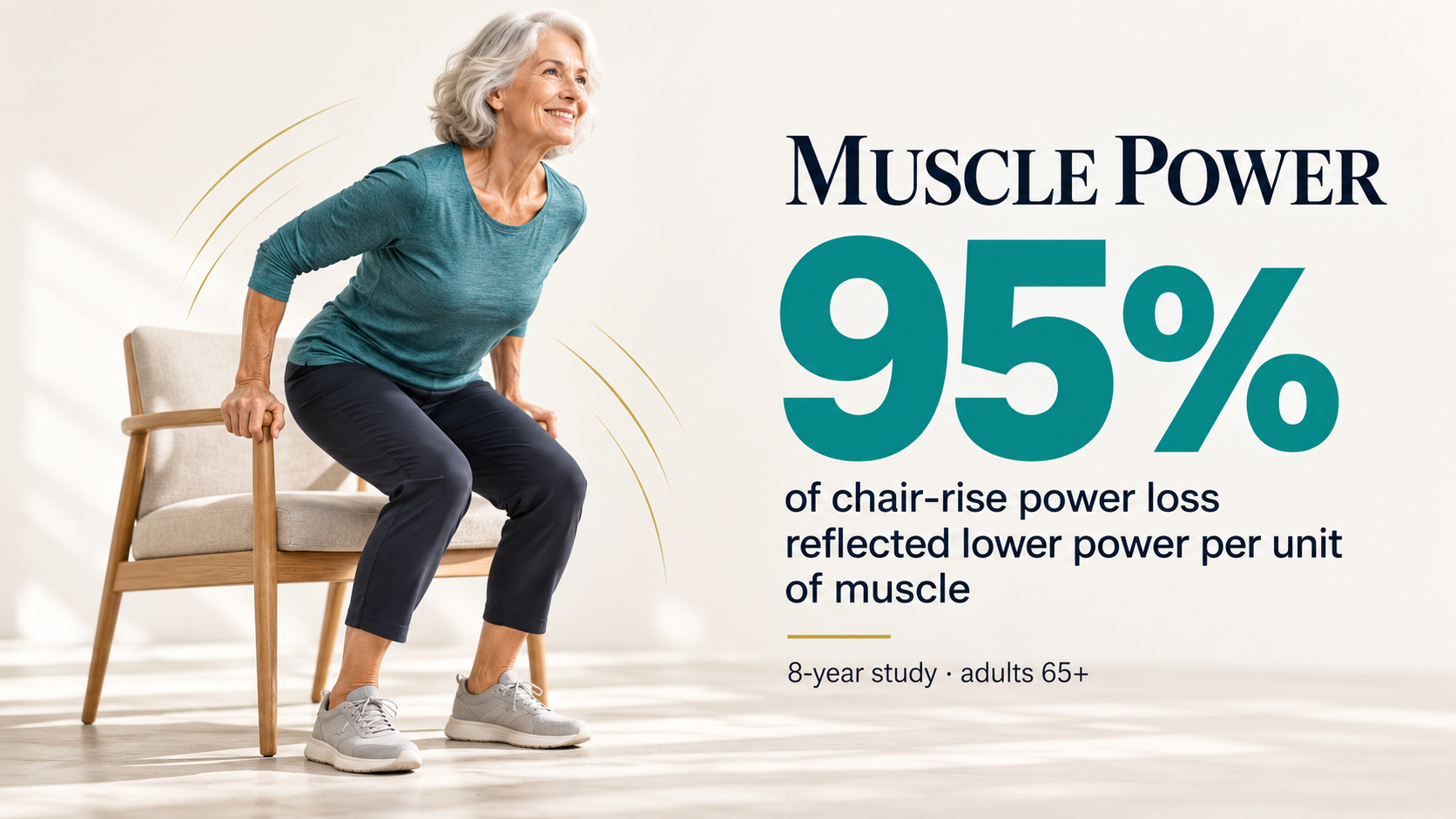
About 95% of the power loss came from muscle producing less power for its size. Only about 5% came from losing leg muscle 1. Holding onto muscle size helps, but it does not protect power on its own. How quickly and forcefully your muscles fire needs its own training. Women who took medications also had higher odds of losing power, which is one reason to look at the whole picture 1.
Where power shows up in daily life
Power matters most in the moments that decide independence:
- Pickleball and tennis: quick starts, hard stops, and sharp changes of direction, with force passed from the legs through the trunk into the racquet.
- Catching a trip or slip: a fraction of a second to get a foot out front and rebuild a stable base.
- Crossing a busy street: speeding up on demand, pushing hard into the pavement.
- Stairs and getting out of a chair: lifting your whole body upward in a short push against gravity.
How power responds to training
In a meta-analysis of 15 randomized trials with 583 older adults, power training built more muscle power than strength training 2. In a trial of 112 older adults around age 69, peak power rose 14 to 15% with explosive training at light, moderate, or heavy loads, compared with 3% in the control group 3. Heavy loads also gave the best overall mix of strength, power, and endurance gains in that trial 3. A systematic review of high-speed resistance training in independent older adults also reported improvements in cognitive, neuromuscular, and physical function 4.
How to train power safely
High-speed power training is a practical approach for older adults 6. Speed and load both need care. Before you start:
- Begin with a load you can move quickly with good form. Speed matters more than weight.
- Start with chair stands, step-ups, or bodyweight movements before adding resistance.
- Rest long enough between sets to repeat each rep at full speed.
- Stop if you feel chest pain, dizziness, shortness of breath that does not settle, or joint pain that is sharp or lasting.
- Check with your clinician first if you have joint, heart, or balance concerns, or if you have recently fallen.
The takeaway
Power is its own capacity, and it can be trained. In the research above, it declined faster than strength with age, and muscle size explained very little of the drop. Slow, heavy lifting alone leaves that gap open. I recommend adding the intent to move the weight quickly, using safe loads and good technique, and checking power along with strength. A simple check is how quickly you can stand from a chair.
Common questions
What is muscle power, and how is it different from strength?
Strength is how much force a muscle can produce. Power is force multiplied by velocity, so it measures how quickly you can produce that force. Standing from a chair, climbing stairs, and catching a stumble all depend on fast force.
How much muscle power do you lose with age?
In an 8-year study of 565 adults aged 65 and older, men lost 11.8% of their chair-rise power and women lost 8.0%. The annual loss reached about 2.0% after age 75. The study shows an association with age and sex, not a cause.
Can older adults improve muscle power with training?
Yes. A meta-analysis of 15 randomized trials with 583 older adults found that power training built more muscle power than strength training. Check with your clinician before starting fast or heavy training, especially with joint, heart, or balance concerns.
References and evidence grades
Every claim above is graded: Established (consistent evidence), Promising (good early evidence, limits noted), or Unproven-Bridge (a reasoned link not yet tested directly).
In 565 adults aged 65 and older followed for 8 years, relative sit-to-stand power fell 11.8% in men and 8.0% in women, and about 95% of the decline came from lower power per unit of muscle. Promising
Baltasar-Fernandez I, Alcazar J, Gómez-Cabello A, et al. Changes and major determinants of relative muscle power loss in older adults: results from an 8-year longitudinal study. Eur J Appl Physiol. 2026;126(3):1737-1750. Epub 2025 Oct 15. doi:10.1007/s00421-025-05947-3 PubMed 41094174
In a meta-analysis of 15 randomized trials with 583 older adults, power training produced a larger benefit on muscle power than strength training. Established
El Hadouchi M, Kiers H, de Vries R, Veenhof C, van Dieën J. Effectiveness of power training compared to strength training in older adults: a systematic review and meta-analysis. Eur Rev Aging Phys Act. 2022;19:18. doi:10.1186/s11556-022-00297-x PubMed 35953775
Peak muscle power rose 14 to 15% with explosive training at 20%, 50%, or 80% of one-repetition maximum, compared with 3% in controls, in 112 older adults around age 69. Promising
de Vos NJ, Singh NA, Ross DA, et al. Optimal load for increasing muscle power during explosive resistance training in older adults. J Gerontol A Biol Sci Med Sci. 2005;60(5):638-647. doi:10.1093/gerona/60.5.638 PubMed 15972618
In a systematic review and meta-analysis of independent older adults, high-speed resistance training improved cognitive, neuromuscular, and physical function. Promising
Martins AD, Fernandes O, Pereira A, Oliveira R, Alderete Goñi FD, Leite NJC, Brito JP. The Effects of High-Speed Resistance Training on Health Outcomes in Independent Older Adults: A Systematic Review and Meta-Analysis. Int J Environ Res Public Health. 2022;19(9). doi:10.3390/ijerph19095390 PubMed 35564788
Muscle power declines earlier and more precipitously with age than strength, and is an important predictor of functional limitation in older adults. Promising
Reid KF, Fielding RA. Skeletal muscle power: a critical determinant of physical functioning in older adults. Exerc Sport Sci Rev. 2012;40(1):4-12. doi:10.1097/JES.0b013e31823b5f13 PubMed 22016147
High-speed power training is a novel approach with preliminary evidence of benefit in older men and women. Promising
Sayers SP. High-speed power training: a novel approach to resistance training in older men and women. A brief review and pilot study. J Strength Cond Res. 2007;21(2):518-526. doi:10.1519/R-20546.1 PubMed 17530980
The National Strength and Conditioning Association recommends resistance training that includes power for older adults. Established
Fragala MS, Cadore EL, Dorgo S, Izquierdo M, Kraemer WJ, Peterson MD, Ryan ED. Resistance training for older adults: position statement from the National Strength and Conditioning Association. J Strength Cond Res. 2019;33(8):2019-2052. doi:10.1519/JSC.0000000000003230 PubMed 31343601
Educational content, not medical advice. It does not diagnose or treat any condition. Talk with your clinician before starting a new exercise program or test. See the medical disclaimer.
Get the Muscle-Meta newsletter
New articles and clinical notes on staying strong after 50, every claim graded. Unsubscribe any time.