Three field tests that estimate your VO2max, and which one fits you
A 12-minute run, a one-mile walk or a six-minute walk can each estimate your aerobic fitness. Here is how they differ and how to choose.
VO2max is the most oxygen your body can take in and use during hard effort. It is the standard measure of cardiorespiratory fitness, and it matters well beyond sport. In a Cleveland Clinic study of more than 120,000 adults, people with below-average fitness had a mortality risk similar in size to smoking or diabetes, compared with people of above-average fitness 1. That is an association, not proof that fitness alone explains the difference, but it is one of the most consistent findings in exercise science.
The encouraging part is that fitness responds to training at any age. The first step is knowing where you start.
Three tests you can do without a lab
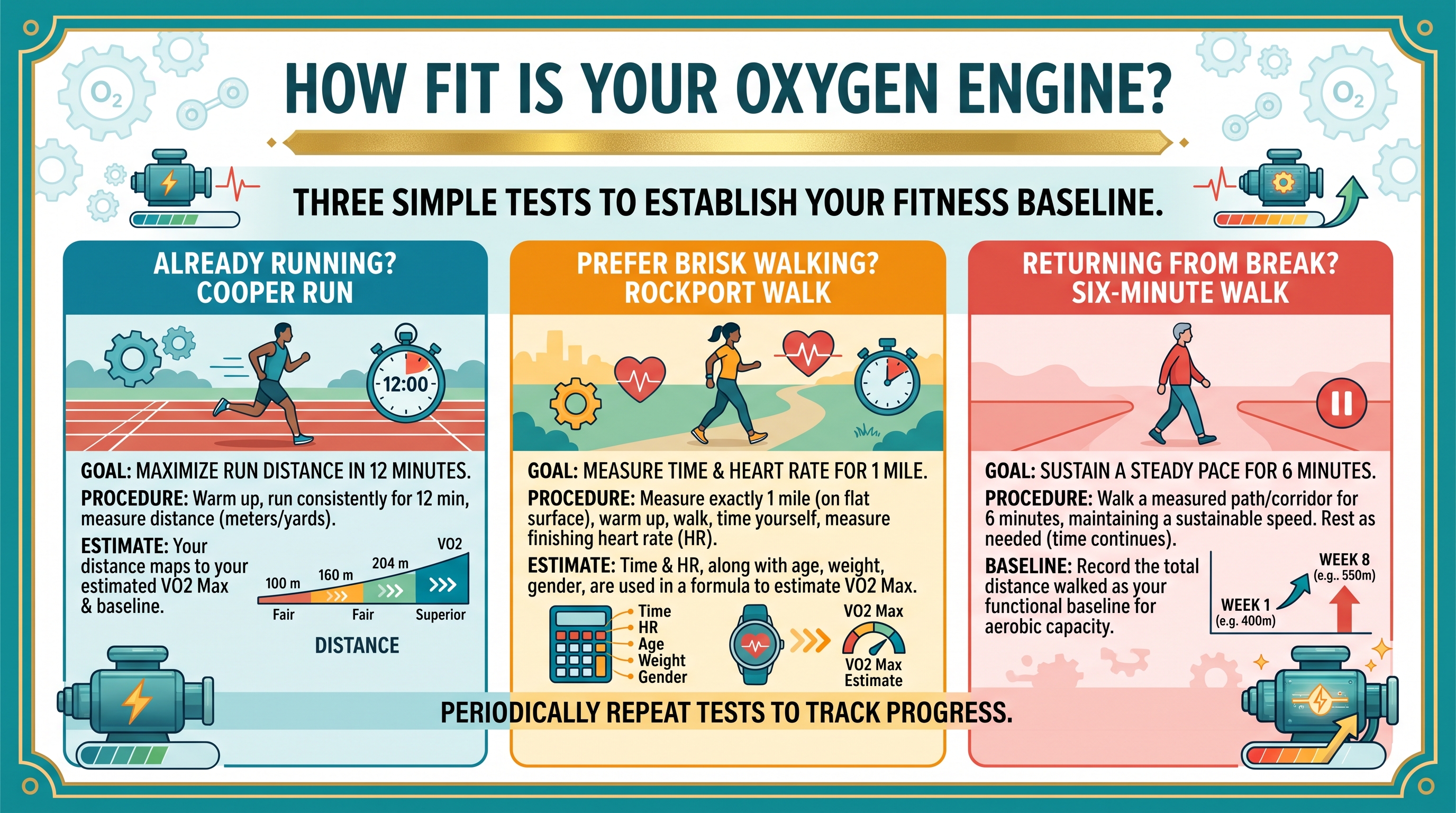
Each test below turns a simple effort into an estimate of VO2max using an equation from a published validation study.
| Test | What you do | Best for |
|---|---|---|
| Cooper 12-minute run | Cover as much distance as you can in 12 minutes | People who already run comfortably |
| Rockport one-mile walk | Walk one mile as briskly as you can, then take your heart rate | Most active adults over 45 |
| Six-minute walk | Walk as far as you can in six minutes at your own pace | Returning after illness, surgery or a long break |
The Cooper 12-minute run
Kenneth Cooper showed in 1968 that the distance covered in 12 minutes of running tracks treadmill-measured oxygen intake 2. It is simple and repeatable, but it asks for a sustained hard effort, and it was developed in men. If running is not already part of your week, choose a walking test instead.
The Rockport one-mile walk
This is the test I recommend for most people reading this. You walk one mile on a flat, measured route as quickly as you comfortably can, then record your time and your heart rate at the finish. In the original study of 343 adults aged 30 to 69, the estimate tracked measured VO2max closely 3. It is demanding enough to be informative without asking you to run.
The six-minute walk
The six-minute walk is the gentlest entry point. It is widely used in clinics because it lets people set their own pace. An equation that adds body weight, sex, resting heart rate and age to the distance walked explained most of the variation in measured VO2max in one study 4. That study was small and its participants were younger than most of our readers, so read the number as a starting point rather than a precise score.
How to test safely
- Warm up with five minutes of easy walking.
- Stop straight away if you feel chest pain or pressure, unusual breathlessness, dizziness or palpitations.
- If you have a heart or lung condition, or you have been told to limit exertion, check with your clinician before any timed test.
- If hard effort leaves you wiped out for a day or more afterwards, skip timed tests for now and talk with your clinician first.
Pick one test and keep using it. The value is in the trend, not in a single number.
What to do with your number
A single estimate tells you where you stand today. Repeating the same test every 8 to 12 weeks tells you whether your training is moving it. The Oxygen Engine below runs all three equations, shows how your result compares for your age and sex, and keeps the screening questions in front of the test.
Estimate your VO2max with the Oxygen Engine
Common questions
Do I need a lab test to know my VO2max?
No. A lab test measures it directly and is the most accurate, but a well-chosen field test gives a useful estimate you can repeat every few months to see whether your training is working.
How often should I retest?
Every 8 to 12 weeks is enough to see change. Use the same test, the same route and similar conditions each time, so the comparison is fair.
References and evidence grades
Every claim above is graded: Established (consistent evidence), Promising (good early evidence, limits noted), or Unproven-Bridge (a reasoned link not yet tested directly).
In 122,007 adults followed for a median of 8.4 years, lower treadmill fitness was linked to higher all-cause mortality, with below-average versus above-average fitness carrying a risk similar to smoking or diabetes. Established
Mandsager K, Harb S, Cremer P, et al. Association of cardiorespiratory fitness with long-term mortality among adults undergoing exercise treadmill testing. JAMA Netw Open. 2018;1(6):e183605. PubMed 30646252 · DOI
Distance covered in 12 minutes of running correlates with treadmill-measured maximal oxygen intake. The original sample was men. Established
Cooper KH. A means of assessing maximal oxygen intake: correlation between field and treadmill testing. JAMA. 1968;203(3):201-204. PubMed 5694044
A brisk one-mile walk, with finishing heart rate, age, sex and weight, estimated VO2max closely (r = 0.92 on cross-validation) in 343 adults aged 30 to 69. Established
Kline GM, Porcari JP, Hintermeister R, et al. Estimation of VO2max from a one-mile track walk, gender, age, and body weight. Med Sci Sports Exerc. 1987;19(3):253-259. PubMed 3600239
Six-minute walk distance, combined with weight, sex, resting heart rate and age, explained 72% of the variation in measured VO2max in 44 healthy working-aged adults. The sample was small and younger than most readers here, so treat results as directional. Promising
Burr JF, Bredin SSD, Faktor MD, Warburton DER. The 6-minute walk test as a predictor of objectively measured aerobic fitness in healthy working-aged adults. Phys Sportsmed. 2011;39(2):133-139. PubMed 21673494 · DOI
Educational content, not medical advice. It does not diagnose or treat any condition. Talk with your clinician before starting a new exercise program or test. See the medical disclaimer.
Get the Muscle-Meta newsletter
New articles and clinical notes on staying strong after 50, every claim graded. Unsubscribe any time.